














Au Pair in America

Au Pair in America Logo

Trust the world's most experienced au pair program.

Phone(800) 928-7247

Culture Quests

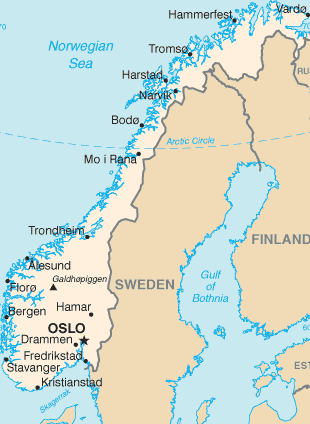
Norway

Europe
Capital: Oslo
Languages: Bokmal Norwegian, Nynorsk Norwegian, small Sami- and Finnish-speaking minorities
Useful links: Kids Culture Corner: Norway | CIA World Factbook

The following information is generalized and compiled from questions posed to the agents and interviewers in Norway. Although au pairs from this country may or may not have had these experiences/beliefs, Au Pair in America wishes to share this general information with our families.

Au Pairs in General

  • The idea of being an au pair is common in Norway.
  • Applicants from Norway are motivated by the opportunity to develop English language skills.
  • The job potential of an au pair does not necessarily improve upon her return to Norway.
  • Applicants do not have difficulty affording the program fees.
  • Young people in Norway have the freedom of their family to socialize and date.
  • Curfews are not common.
  • Young women are accustomed to sharing in household chores.
  • Nudity is accepted, especially by young people. Topless sunbathing is common.
  • Norwegians like outdoor sports, are well-educated, and appreciate equality.

Child Care Practices

  • Physical discipline is not common in Norway.
  • Applicants obtain childcare experience through formal schooling, babysitting, and working in preschools.
  • Usually both parents share the childrearing responsibilities.
  • It is common for both parents to work and be away from home during the day.

Driving Skills

  • The minimum driving age is age 18. Most applicants obtain their driving license at age  18.
  • A driving license is not difficult to obtain, but it is expensive.
  • The steps involved in obtaining a driving license in Norway include:
    • Driving lessons
    • Theoretical test
    • Practical test, includes winter driving
    • Fees
  • The International driving permit is available.
  • Applicants typically take formal driving lessons and practice driving using their parents’ car.
  • Most cars have manual transmissions.

English Language Skills

  • English is compulsory from age nine.
  • Classes focus on both oral and written English. Many watch TV in English to help with comprehension.

Education

  • Approximately 50% of young women continue their studies at university.
  • Those who do not attend university study in professional schools, or work in offices or retail stores.
  • The academic year in Norway starts in August and ends in June.
  • University is free is Norway. The most important educational opportunity is to improve their English.

Health

  • The most common inoculations are tetanus, measles, mumps, rubella, tuberculosis, and polio.
  • Most young women are inoculated and tested for TB (tuberculosis).
  • Norway has a free health service.
  • Most young women visit the dentist on a regular basis.
  • “Eating disorders” are not common, but do occur.

Diet

  • Most young people in Norway eat meat.
  • Vegetarianism is not common.
  • The typical diet in Norway includes seafood, meat, dairy and fruits.

Religion

  • The most common religion in Norway is Lutheran.
  • Most young people in Norway do not practice their religion regularly.

Telephone & Internet

  • Most homes have a telephone and a computer with access to the Internet.
  • Family members will be able to take a message in English from a potential host family.

Login to your Account

New to Au Pair in America?
Apply or request information.


Special Promotion

New host families:

Apply for $100
before January 15th.
That's a savings of $250!

View details & discounts.


Home | About Us | Program Options | Our Au Pairs | Au Pairs Available Now | Fees | Applying | Request Information | Contact Us
Resources for Current Host Families | Resources for Current Au Pairs

All contents copyright © Au Pair in America / American Institute For Foreign Study. Privacy Policy | Careers | For the Media | Contact Us