













AU PAIR CULTURE QUESTS

AUSTRALIA
Between the Indian Ocean and
South Pacific Ocean
Capital: Canberra
Languages: English
Predominant Religion(s): Christianity


 Flag of Australia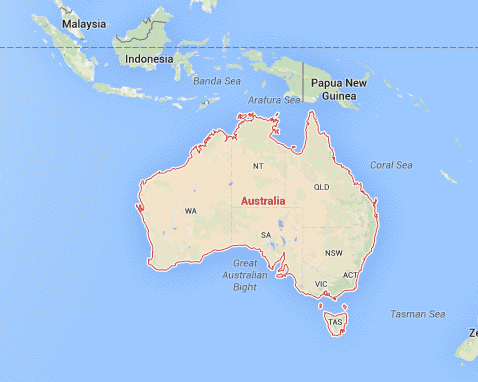

The following information is generalized and compiled from questions posed to the agents and interviewers in Australia. Although au pairs from this country may or may not have had these experiences/beliefs, Au Pair in America wishes to share this general information with our families.
Child Care Skills
- Australians obtain child care experience through formal schooling, babysitting, tutoring, working at summer camps, coaching sports, teaching Sunday School, involvement with guide or scout groups and working in child care centers.
- The mother is still typically the main caregiver, but more and more families are now opting for a more even role between parents. Approximately 65% of mothers work full time or part time.
- Common discipline techniques include time out and loss of privileges, e.g. no television for a week, sitting in a certain spot for a few minutes.
Family
- It is common for people to marry or be in a civil relationship.
- The most common family group is two adults and two children.
- Due to escalating house prices, many young Australians live at home until they are 30. The average Australian home is a three- or four-bedroom, free-standing home.
English Skills
- English is the main language of Australia
Driving Skills
- Australians drive on the lefthand side of the road, so au pairs will need practice in the U.S.
- The minimum age to gain a learning permit is 16 or 17 depending on the state the au pair lives in. Most applicants gain their license between 17 and 19.
- Before passing a test, learners must have a permit for 12 months and complete 120 hours of supervised practice, including 10 hours of nighttime driving.
Education
- The academic year in Australia starts in February and ends in November.
- In general, children are required to attend school from age 5 until age 16 or 17, depending on which state they live in.
- Most Australian children play a sport at school, and many are involved with guides, scouts, dancing, music, and theater.
Health
- Australia has a free health service for all Australians known as Medicare, and some people will also have private insurance.
- The states manage hospitals and attached outpatient services, while the Commonwealth funds the Pharmaceutical Benefits Scheme (subsidizing the costs of medicines) and general practice.
- It is common to visit the dentist every six months.
COMMON CHARACTERISTICS:
- Australians are quite direct and will freely discuss a range of subjects.
- Most Australians grow up believing that everyone should have equal rights and be treated the same. Australia was the second country in the world to allow women the vote.
- About 26% of the population was born overseas and 40% have a parent born overseas, so there is a lot of diversity. Many Australians feel that Australia has a culture and identity based on friendship, honesty, sports, and multiculturalism.
FUN FACTS:
- The largest Greek population in the world other than in Athens is in Melbourne, Australia.
- Australia was settled by convicts (criminals) sent over from the UK. The first police force was made up of the 12 most well-behaved convicts.
- The black box, wine cask, bionic ear, ultrasound and pacemakers were all invented in Australia.
“It’s a fantastic opportunity that you will never regret. It’s difficult at first being away from your family and friends, but the experience overall is invaluable.” – Janelle, au pair from Australia
“Go with an open mind, be willing to try new things, be adventurous – take every opportunity.” – Karli, au pair from Australia
“Go for it, it was the best year of my life hands down!”– Sarah, au pair from Australia
“I love that my children are learning about another culture. I like that I can feel good about the excellent and loving care that my kids receive while I am at work.”
Lori, host parent
Wisconsin